
Sports
Size of Soccer Field by Age and Team: Full Rules and Dimensions


The size of a soccer field is one of the most misunderstood aspects of the game. Soccer is different from other sports because the size of the field can change depending on the age of the players, the level of play, and the rules of the competition. The size of a soccer field is carefully changed to find the right balance between player safety, development, and the flow of the game. This is true for everything from small-sided youth games to international tournaments. This guide uses official standards to explain the sizes of soccer fields at all levels. It does so in a way that is simple, useful, and easy to understand.
Why the size of soccer fields is different in different places
There are many places where people play soccer, from parks in their own neighborhoods to world-class stadiums. A single field size wouldn’t work for every situation because players come in all ages, strengths, and skills. FIFA, IFAB, US Youth Soccer, NFHS, NCAA, and US Soccer all allow size ranges instead of exact measurements. This flexibility helps younger players learn the game without getting too stressed out, and it lets facilities make the most of the space they have while still following the Laws of the Game.
The number of players is another important reason for the difference. A field made for 22 players would feel empty for a 5-a-side game, and a small pitch would be too dangerous and limiting for a full professional game. Changing the size of the soccer field makes sure that the game is fair, fun, and safe at all levels.

The standard size of a soccer field for professional and international games
Soccer fields have stricter rules at the highest levels, especially for international competitions. Even then, there is still a range of sizes that are acceptable, not just one.
FIFA’s Rules for Full-Size Soccer Fields
FIFA and IFAB set the rules for professional and international soccer fields. For high-level international games, like World Cup games, fields must be within a small range to make sure that all venues are the same. No matter where you are, these standards help keep the game fair and the playing conditions predictable.
How big is a soccer field in feet, yards, and meters?
The table below shows the size range that most people agree on for professional and international soccer fields.
| Measurement Unit | Length Range | Width Range |
|---|---|---|
| Yards | 110 to 120 yards | 70 to 80 yards |
| Meters | 100.6 to 109.7 m | 64.0 to 73.2 m |
| Feet | 330 to 360 ft | 210 to 240 ft |
In order to balance speed, space, and tactical play, the majority of professional clubs select dimensions that fall somewhere in the middle of this range.
Soccer Field Size by Age Group
Reduced fields are used in youth and school soccer to accommodate player development. The size of the field and the demands of a match gradually increase as players get older.
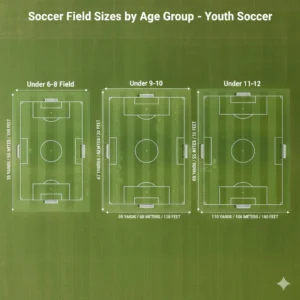
Field Sizes for Young Soccer Players
Smaller fields allow for more ball touches and less physical strain, which is advantageous for younger players. As players progress through age groups, fields get bigger.
| Age Group | Typical Field Length | Typical Field Width | Common Format |
|---|---|---|---|
| Under 6–8 | 25–35 yards | 15–25 yards | 3v3 to 5v5 |
| Under 9–10 | 55–65 yards | 35–45 yards | 7v7 |
| Under 11–12 | 70–80 yards | 45–55 yards | 9v9 |
The objective is always to promote learning and enjoyment rather than physical dominance, though these dimensions may differ slightly by league.
High School Soccer Field Size
In the US, high school football adheres to NFHS regulations. Although the permitted range is greater than international norms, games are played on full-size fields. This makes it possible for schools to use current facilities while still adhering to regulations. High school fields are usually 55 to 80 yards wide and 100 to 120 yards long.
College Soccer Field Size
The NCAA is in charge of college soccer. Professional and college fields are comparable, but they are frequently a little more specialized. Typically, the width is between 70 and 75 yards, and the length is between 115 and 120 yards. For elite amateur athletes, these dimensions facilitate a quick, competitive style of play.
Soccer Field Size Determined by Player Count
The popularity of small-sided soccer formats for recreational play and youth development has increased. To keep the game interesting and dynamic, each format employs a different field size.

Size of a 5-a-Side Soccer Field
A 5-a-side soccer field is small and made for fast play and continuous participation. Typically, fields are 30 yards wide and 40 yards long. Smaller goals and constrained space encourage close control and quick passing in these games, which are frequently played indoors or on artificial turf.
Size of a 6-a-Side Soccer Field
It is common to play 6-a-side soccer on enclosed or indoor fields. Competition-specific dimensions vary, but many are roughly 30 yards wide and 60 to 70 yards long. These fields are enclosed, which keeps the ball in play and quickens the game.
Size of a 7-a-Side Soccer Field
In many areas, a typical 7-a-side soccer field is about 60 yards long and 40 yards wide. The objective is to provide adequate room for passing and movement without sacrificing the intensity that characterizes small-sided soccer, although international guidelines permit some variation.
Size of a 9-a-Side Soccer Field
Small-sided and full soccer are connected by 9-a-side soccer. Typically, fields are 50 yards wide and 80 yards long. When preparing for 11-a-side games, older youth players frequently use this format.
11-a-Side Soccer Field Dimensions
The largest field dimensions are used in the traditional game. A wide range, from 100 to 130 yards in length and 50 to 100 yards in width, is permitted for recreational and domestic matches. As previously mentioned, professional and international matches are subject to more stringent restrictions.
Explanation of Soccer Field Markings and Lines
On a soccer field, each line serves a function directly related to the game’s regulations. For fair officiating and appropriate gameplay, accurate markings are crucial.
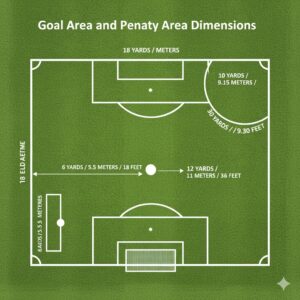
Goal lines and touchlines
Goal lines indicate the ends of the field, while touchlines run the length of it. Play is restarted based on which team last touched the ball when it completely crosses these lines. The playable area is defined by these boundary lines, which must be easily observable.
Sizes of the Goal and Penalty Areas
A tiny rectangle in front of each goal is known as the goal area, or “six-yard box.” It is 20 yards across and 6 yards from the goal line. The penalty area is wider, measuring 44 yards in width and 18 yards from the goal line. Where penalty kicks are awarded and where goalkeepers can handle the ball are determined by this area.
Arc, Center Circle, and Penalty Spot
The penalty spot, which designates the spot for penalty kicks, is 12 yards from the goal line. During a penalty, the arc at the top of the penalty area makes sure that other players stay the proper distance away. At kickoff, player positioning is managed by the center circle, which has a radius of ten yards.
Halfway Line and Corner Arcs
Corner arcs, which have a radius of one yard, indicate the locations of corner kicks. In addition to dividing the field into two equal halves, the halfway line is crucial for kickoff and offside decisions.
Goalpost Dimensions and Football Field Equipment
Goalposts for full-size soccer are 24 feet wide and 8 feet high. At higher levels of play, posts and crossbars typically have a rounded shape and need to be firmly anchored. Essential equipment needed for regulation matches includes nets, corner flags, and clearly marked lines.
Field Conditions and Playing Surface
Performance and safety are significantly impacted by the playing surface’s quality. As long as the surface satisfies competition requirements, soccer can be played on artificial turf or natural grass.
Types of Grass Used on Soccer Fields
Depending on the climate, natural grass fields frequently employ hardy types like Kentucky bluegrass, ryegrass, or Bermuda grass. In regions with high traffic or severe weather, artificial turf is popular because it provides year-round conditions.
Suggested Length and Drainage of Grass
Usually, grass is maintained at a height of 20 to 30 millimeters. In order to avoid water accumulation, which could endanger the field and impair ball movement, proper drainage is essential.
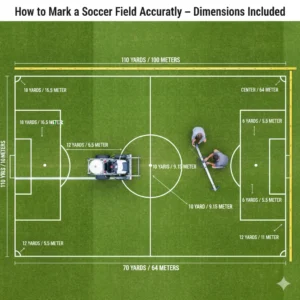
How to Indicate a Soccer Field’s Correct Size
Precise field marking establishes a professional playing environment and guarantees adherence to rules.
Equipment and Tools Required for Field Marking
Measuring tapes, marking stakes, string lines, and line-marking machines are examples of common tools. To maintain uniform dimensions, penalty spots and arcs are frequently created using specialized templates.
Advice for Determining Precise Field Dimensions
Mark the corners and goal lines first, then measure inward for important locations like the center circle and penalty box. Before painting, double-check all measurements to prevent expensive adjustments down the road.
FAQs Regarding Soccer Field Size
The Size of a Soccer Field in Acres
Depending on its precise measurements, a full-size soccer field usually spans 1.6 to 2.0 acres.
What Is the Size of a World Cup Soccer Field?
According to FIFA’s stringent international regulations, World Cup games are played on fields that are 110–120 yards long and 70–80 yards wide.
Football and basketball fields are larger than soccer fields.
Basketball courts are much smaller than soccer fields, while American football fields are marginally smaller overall. Football fields have end zones but are generally narrower than basketball courts, which are small indoor surfaces.
The number of players on a soccer field
Each team has eleven players on the field during a regulation game, plus a goalie, for a total of twenty-two players.
Final Thoughts
A soccer field’s dimensions are never arbitrary. It is carefully selected to fit the players, the format, and the competitive level. Knowing the dimensions of a soccer field can help create safer environments, better games, and more enjoyable experiences for all parties involved, whether designing a professional stadium, a school field, or a youth training pitch. Facilities can guarantee that their fields are suitable for the beautiful game at any level by adhering to official regulations and taking practical requirements into account.


People always pay attention to the Iowa women’s basketball schedule, and this season is no different. Iowa’s schedule has a lot for fans to keep an eye on, including tough road games, exciting home games, and important conference games.
Knowing the whole schedule will help you stay connected all season long, whether you plan to go to games, watch from home, or just keep an eye on the team’s progress. Take a closer look at Iowa’s women’s basketball journey, including tests at the start of the season, conference play, and the postseason.
Iowa Women’s Basketball Full Schedule Table
Below is a simplified and fan-friendly schedule table highlighting key matchups throughout the season. Times and broadcast details may vary.
| Date | Opponent | Location | Venue | Type |
|---|---|---|---|---|
| Nov 3 | North Dakota State | Home | McLeod Center | Non-Conference |
| Nov 9 | Saint Louis | Away | Chaifetz Arena | Non-Conference |
| Nov 16 | Iowa | Home | McLeod Center | Non-Conference |
| Nov 20 | Creighton | Away | Omaha, NE | Non-Conference |
| Nov 26 | Northern Arizona | Neutral | Las Vegas, NV | Tournament |
| Nov 28 | UNLV | Away | Las Vegas, NV | Tournament |
| Dec 3 | Illinois State | Home | McLeod Center | Non-Conference |
| Dec 6 | Toledo | Away | Savage Arena | Conference |
| Dec 14 | Iowa State | Away | Hilton Coliseum | Non-Conference |
| Dec 21 | St. Thomas | Away | St. Paul, MN | Non-Conference |
| Dec 29 | Valparaiso | Away | Indiana | Conference |
| Jan 4 | Southern Illinois | Home | McLeod Center | Conference |
| Jan 18 | Bradley | Home | McLeod Center | Conference |
| Feb 7 | Indiana State | Home | McLeod Center | Conference |
| Mar 8 | Drake | Home | McLeod Center | Conference |
| Mar 12–15 | MVC Tournament | Neutral | Coralville, IA | Postseason |
A look back at the Iowa women’s basketball season
The Iowa women’s basketball team has a tough schedule this season that includes both non-conference games and a long stretch of games in the Missouri Valley Conference. The team will play in tournaments on neutral sites and at home at the McLeod Centre. They will also travel to other states.
This season is meant to test how deep, consistent, and strong you are. Every game, from the first tip-off in November to the last tournament in March, affects the chances of making the playoffs.
Setting the Tone with Early Non-Conference Games
The Iowa women’s basketball team’s early schedule is meant to get them ready for tougher games later in the year. These games often feature strong regional teams and programs that are ranked nationally.
Non-conference games are important because:
- It helps the team get into a groove early on.
- Coaches try out different lineups and rotations.
- Wins give you more confidence going into league play.
Road trips at the start of the season can be hard, but they also help you get stronger mentally.
Games at Home at McLeod Centre
Iowa still has a big advantage when they play at home. The McLeod Centre is a familiar place for fans, and they are very supportive, which can make a big difference in close games.
Fans who go to home games can expect:
- Tough conference matchups
- Rivalry games that are even more intense
- A chance to watch the team get better over the course of the season
Keeping your home court safe is always important, especially during conference play.
Conference Play: The Season’s Definition
The Iowa women’s basketball schedule is mostly made up of conference games. These games often feel like chess matches because the teams know each other’s strengths and weaknesses.
- Important things to remember during conference play:
- It’s more important to be consistent than to win one game.
- Winning on the road is worth more.
- Late-season momentum can decide how teams are ranked in a tournament.
- Playing in two conferences in a row also tests your fitness and recovery.
Things to Watch Out for on the Road
Road games can make or break a season, especially when playing against tough conference teams. Players have to stay disciplined and focused when they play in places that are hostile.
Some road games are more interesting because of
- Tired from travelling
- Crowds that are loud
- Opponents fighting for a spot in the standings
- Winning on the road is often what sets contenders apart from the rest.
Games and tournaments at neutral sites
Neutral site Early-season tournaments are more than just games; they are ways to get ready.
Some benefits of games played at neutral sites are:
- Play without the advantage of home court
- Playing in different ways
- Get used to dealing with tight schedules in a short amount of time.
- These games are often as intense as basketball games in the playoffs.
Important Matchups Fans Should Watch
There are always games that feel bigger than the rest. Rivalries, ranked opponents, and games at the end of the season are all very important.
Fans should pay attention to:
- Games against rivals from the same state
- Games against the leaders of the conference
- Last home games of the regular season
These games often have a direct effect on where teams end up in the playoffs.
How to Watch and Keep Up with the Games
Most of the Iowa women’s basketball games can be streamed or watched on regional TV. Fans on the go still like to listen to the radio.
Staying in touch through official team channels makes sure you can get to:
- Updates to the schedule
- Highlights of the game
- News about injuries and lineups
What This Schedule Means for Iowa’s Season
The schedule for this season is meant to be hard for Iowa at every level. Early tests get the team ready, conference play makes them better at what they do, and postseason tournaments reward teams that keep doing what they do well.
What will make you successful is:
- Being healthy
- Winning important games at home
- Taking important road wins
- Every game is a step towards the bigger goal.
Final Thoughts
The Iowa women’s basketball schedule has a full season of fun, challenges, and chances. Fans can expect competitive basketball and steady growth from the team from the first tip-off to the MVC Tournament.
This season has a lot of great moments for both old and new fans to enjoy. Keep the schedule close by, write down the dates on your calendar, and get ready for another exciting year of Iowa women’s basketball.
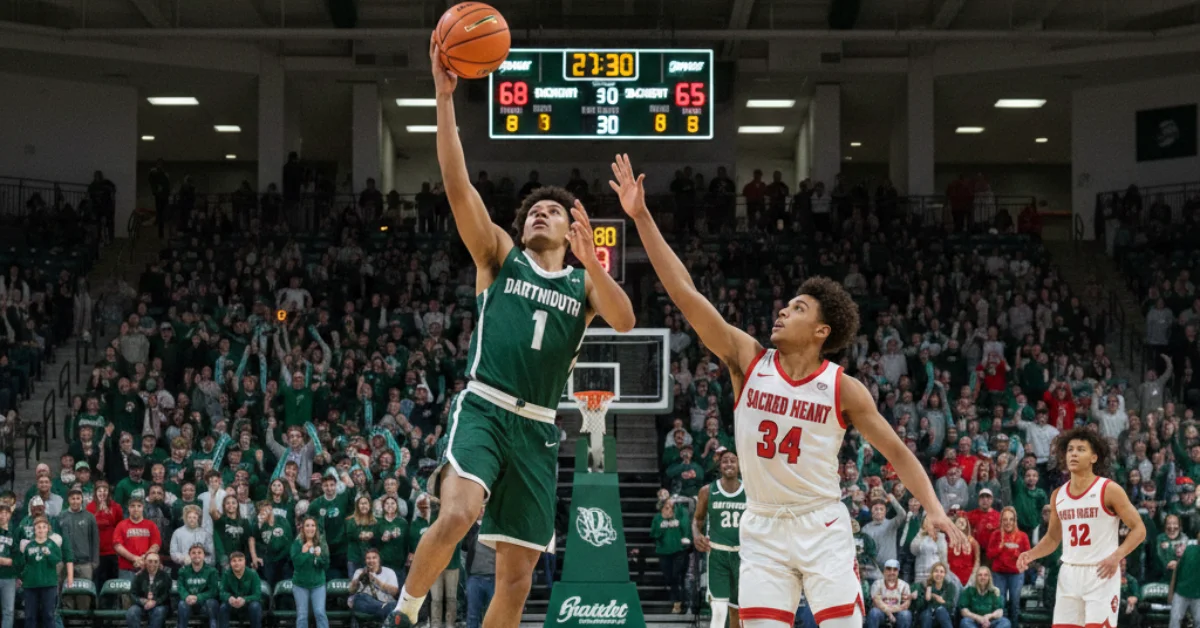
On Friday, December 19, 2025, Dartmouth will play Sacred Heart in a college basketball game that isn’t part of a conference. Fans can expect a close game because both teams want to keep their good season going. The game starts at 11 a.m. ET at the Pitt Centre in Fairfield, Connecticut.
Dartmouth vs. Sacred Heart: A Look at the Matchup
Dartmouth is coming into this game after a strong showing, having beaten Holy Cross 89-64 in their last game. The team wants to win their third game in a row. Sacred Heart, on the other hand, just lost to Massachusetts-Lowell by a narrow 87-82 margin, so this is an important game for both teams.
Dartmouth and Sacred Heart have played each other four times, and the series is tied at two wins each. Dartmouth won the last game, 81-76. These matchups have always been close, so fans should expect another close game.
Lines and Odds for Betting
Based on the most recent betting lines:
- Sacred Heart is favoured by 1.5 points.
- Dartmouth is -103 on the moneyline, and Sacred Heart is -117.
- Over/Under: 155.5 points
The odds on the game suggest that it will be close, with Sacred Heart having a small advantage as the home team. Fubo lets fans stream the game live, and new users can try it out for free.
Team Form and Important Players Dartmouth
Dartmouth’s recent form shows that their offence is doing very well, with players like these standing out:
- Kareem Thomas scored 16 points in the last game, which shows that he can score well.
- Jackson Munro had 11 points, 7 rebounds, and good defence.
- Brandon Mitchell-Day had 13 rebounds and controlled the boards.
The team has scored an average of 55 points in their last game and shot 33.3% from the field. Their ability to stay disciplined on defence will be important against Sacred Heart’s offence.
Sacred Heart
Sacred Heart has been in most of their games this season, but they just lost a close one. Their main scorers and rebounders are some of the most important players to watch. The team’s home-court advantage and the fact that they are slight favourites in the betting line make them a threat, especially in a game that is expected to be low-scoring and defensive.
Dartmouth vs. Sacred Heart: A Look at the Predictions
Using information from advanced projections and past patterns:
- SportsLine simulations show that the game will have a moderate number of points, with a total of about 150 points.
- In 60% of simulations, the under 155.5 points has hit, which means that there will be a defensive battle.
- Dartmouth has been winning a lot lately, and Sacred Heart has been tough, so this is a close contest.
Important Factors
Defensive battles: Both teams have shown that they can give up fewer points in important games.
Close historical matches: The last four meetings were evenly split, showing no clear winner.
Player form: Key players like Kareem Thomas and Jackson Munro could decide who wins.
| Category | Dartmouth | Sacred Heart | Notes / Prediction |
|---|---|---|---|
| Last Game Result | Win 89-64 vs Holy Cross | Loss 87-82 vs UMass-Lowell | Dartmouth on 2-game winning streak, Sacred Heart lost narrowly |
| All-Time Series | 2 Wins | 2 Wins | Series tied, last match 81-76 to Dartmouth |
| Spread | +1.5 | -1.5 | Sacred Heart slight favorite |
| Moneyline | -103 | -117 | Close match expected |
| Total Points (O/U) | – | 155.5 | Under favored in simulations |
| Key Players | Kareem Thomas (16 pts), Jackson Munro (11 pts, 7 reb) | Top scorers TBD | Player performances likely to decide game |
| Predicted Winner | Dartmouth (by narrow margin) | Sacred Heart | Close game, likely within 5 points |
| Predicted Total Score | 75 | 75 | ~150 points total, defensive battle expected |
Dartmouth vs. Sacred Heart Betting Tips
Based on recent stats and form, here are some tips:
Because of how often the defence wins, you might want to bet on the under 155.5 points.
A close spread means a win by a small margin, so expect the game to be within 5 points.
Key players’ performances, like Kareem Thomas scoring more than 15 points, could affect prop bets.
How to Watch the Game
When: Friday, December 19, 2025, at 11 a.m. ET
Place: Pitt Centre, Fairfield, Connecticut
Streaming: Fubo has it (with a free trial)
Final Conclusion
The game between Dartmouth and Sacred Heart should be close and competitive. Dartmouth has the momentum, while Sacred Heart uses its home field advantage and the fact that the two teams have been even in the past. Fans can expect a game with a moderate number of points scored and big plays from star players.
This game is sure to be exciting whether you’re watching for college basketball or betting tips.

When you watch a basketball game or are new to the sport, one of the first things that comes to mind is how many quarters in basketball. It’s easier to follow the game when you know how it’s broken up. It seems fast, exciting, and sometimes long.
Basketball isn’t played all at once; it’s played in parts. These breaks give coaches a chance to change their strategies, give players a chance to rest, and help keep the game moving at the right speed. Most people know that basketball has quarters, but the exact layout changes depending on how high the level of play is.
In this guide, we’ll make everything easier. You will learn how many quarters there are in basketball, how long a typical basketball game lasts, how long a college basketball game lasts, and why different leagues use different formats.
How many quarters are there in a basketball game?
Most basketball games have four quarters. This format is used by professional leagues and many international tournaments.
The whole game is made up of four quarters, and each quarter has a set amount of time. After the second quarter, there is a longer break called halftime. The game is over when the fourth quarter ends, unless the score is tied.
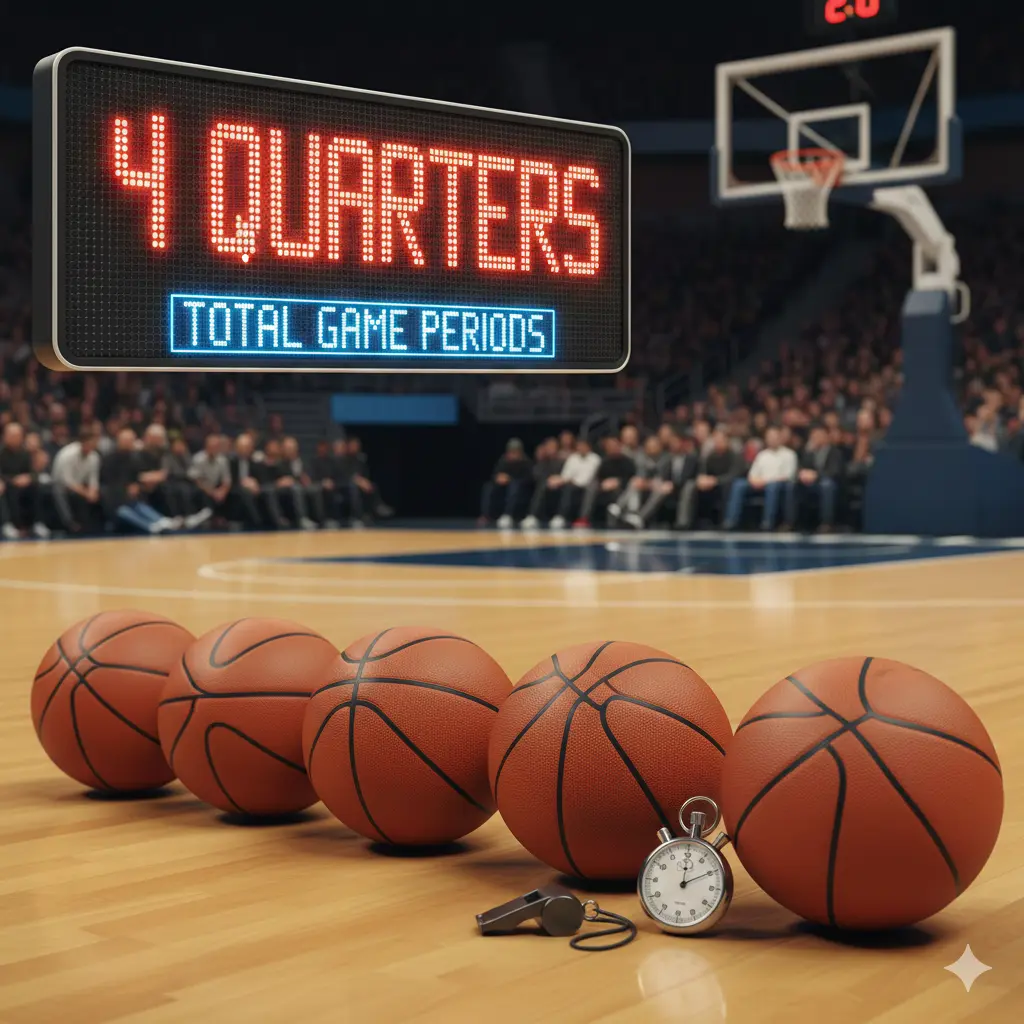
Four quarters is the most common setup, but it’s not used everywhere. Some leagues, especially those at the college level, use a different system. Later, we’ll talk about that in more detail.
The short answer is that basketball usually has four quarters, but this can change depending on the level being played.
how long is a basketball game Last?
It’s not as simple as adding up the minutes on the clock to find out how long a basketball game lasts.
The time it takes to play a basketball game is much shorter than the time it actually takes. This is because the clock often stops for timeouts, free throws, fouls, and reviews.
Most basketball games last between two and three hours. This includes:
- Every three months
- At halftime
- Breaks
- Stops
- Possible extra time
Commercial breaks often make televised games last longer. Close games last longer because teams take more timeouts at the end.
Understanding Game Time and Quarters in Basketball
To really understand basketball, you need to know how the clock works. Basketball has a stop-and-go clock, so time only moves when the ball is in play.
When the referee blows the whistle, the clock stops. This makes the game longer and more exciting at the same time. In the last few minutes of a close game, it can take a lot longer than you think.
Quarters help break up the action into smaller, easier-to-understand pieces. Instead of playing all the time, teams take short breaks to rest and get ready. Also, fans can take a break and follow the story of the game.
What Quarters Are Used for in Basketball
Basketball is a tough sport. Players are always on the move, whether they’re running, jumping, attacking, or defending. To keep the level of play high, the game is split into quarters.
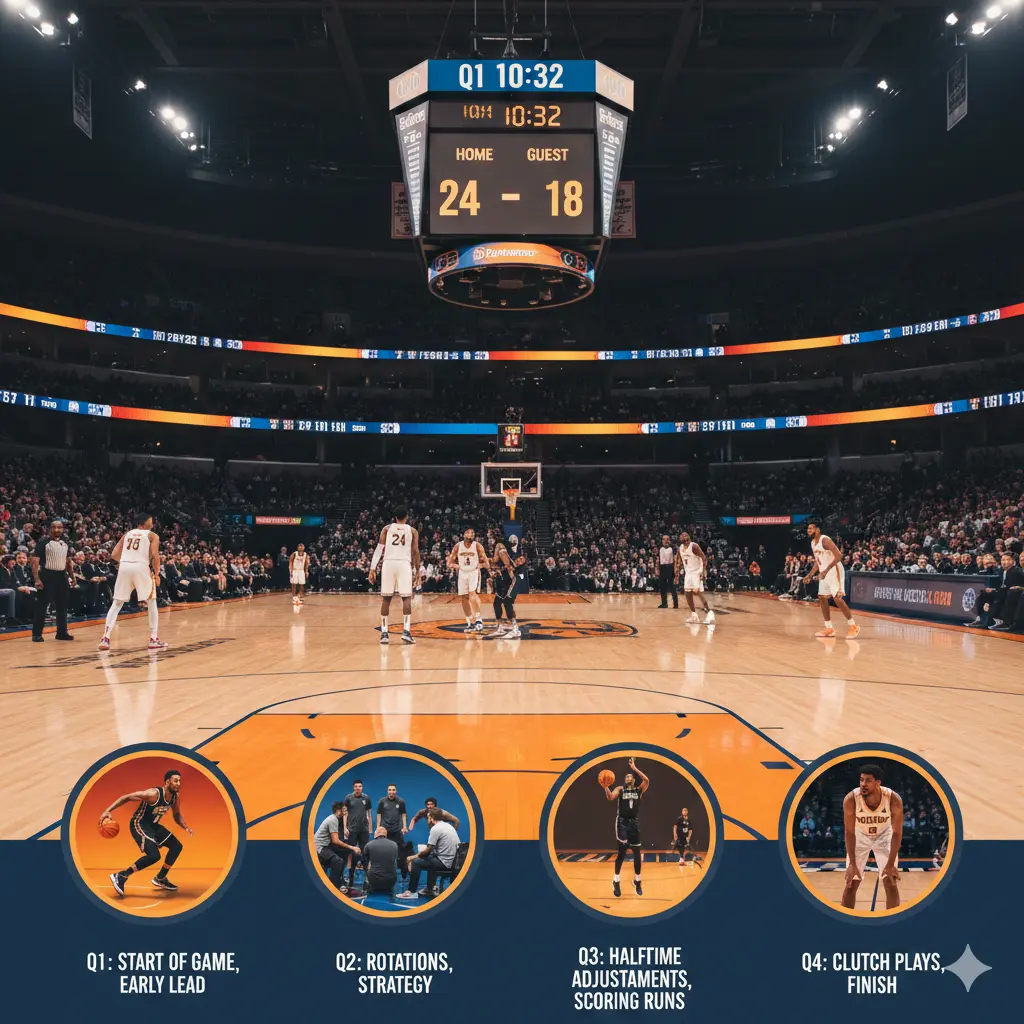
This is why quarters are so important:
- Players don’t get very tired.
- Coaches can change their plans
- The game is still fair and competitive.
- Taking breaks lowers the risk of getting hurt.
Quarters also make drama happen. Each one feels like a mini-battle, especially in the fourth quarter, when the game is often decided.
What Happens During Breaks and Halftime
There is a short break between each quarter. During these breaks, which usually last a few minutes, teams can switch sides of the court.
There is a much longer halftime after the second quarter. During halftime, players take a break, coaches talk about strategy, and fans can watch entertainment or get snacks.
Halftime is important because teams can reset then. A team that didn’t do well in the first half can do better in the second half.
How long does a basketball game last at different levels?
There are differences between basketball games. The number of quarters and the total game time may change depending on the level being played.
Let’s look at how long basketball games last at different points in time.
How long does an NBA basketball game last?
There are four quarters in an NBA game, and each one lasts twelve minutes.
This means that the real playing time is 48 minutes. But NBA games usually last about 2.5 hours because they stop a lot.

NBA games seem to last longer because:
- There are a lot of timeouts.
- Fouls are often called
- More often than not, reviews happen.
- There are now TV ads.
The fourth quarter of an NBA game is especially long because teams slow down when the score is close.
How long does a college basketball game last?
A lot of people ask how long a college basketball game is, and the answer surprises them.
In college basketball, there are no four quarters. It is split into two parts of 20 minutes each.
This means that even though the structure is different, the total playing time is still forty minutes. College games usually last two to two and a half hours, but they have fewer breaks than NBA games.
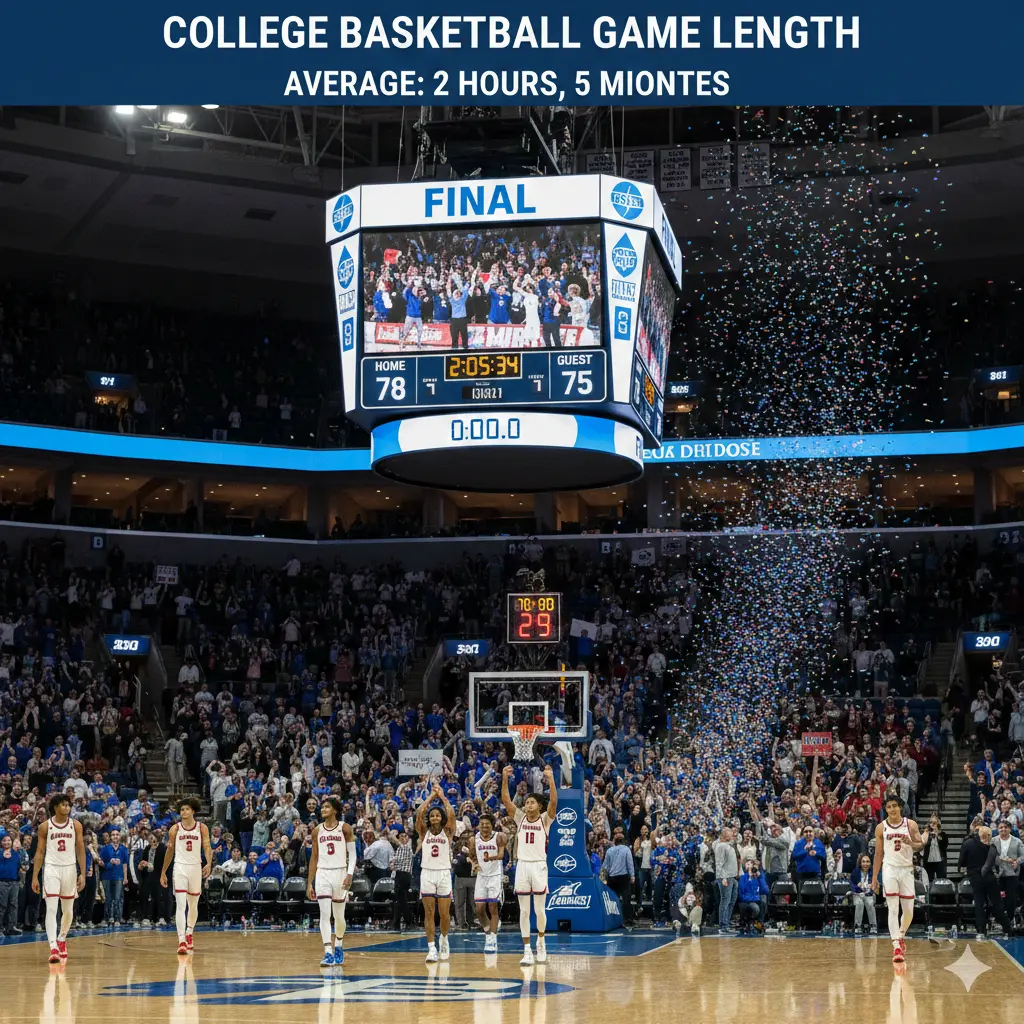
College games feel different because they flow better, but fouls and free throws can still slow things down at the end of the game.
How long does a basketball game in high school last?
High school basketball games are shorter and meant for younger players.
Most high school games are split into four quarters, each of which lasts eight minutes.
The total time spent playing is 32 minutes. High school games usually last between 1.5 and 2 hours, with breaks and stoppages.
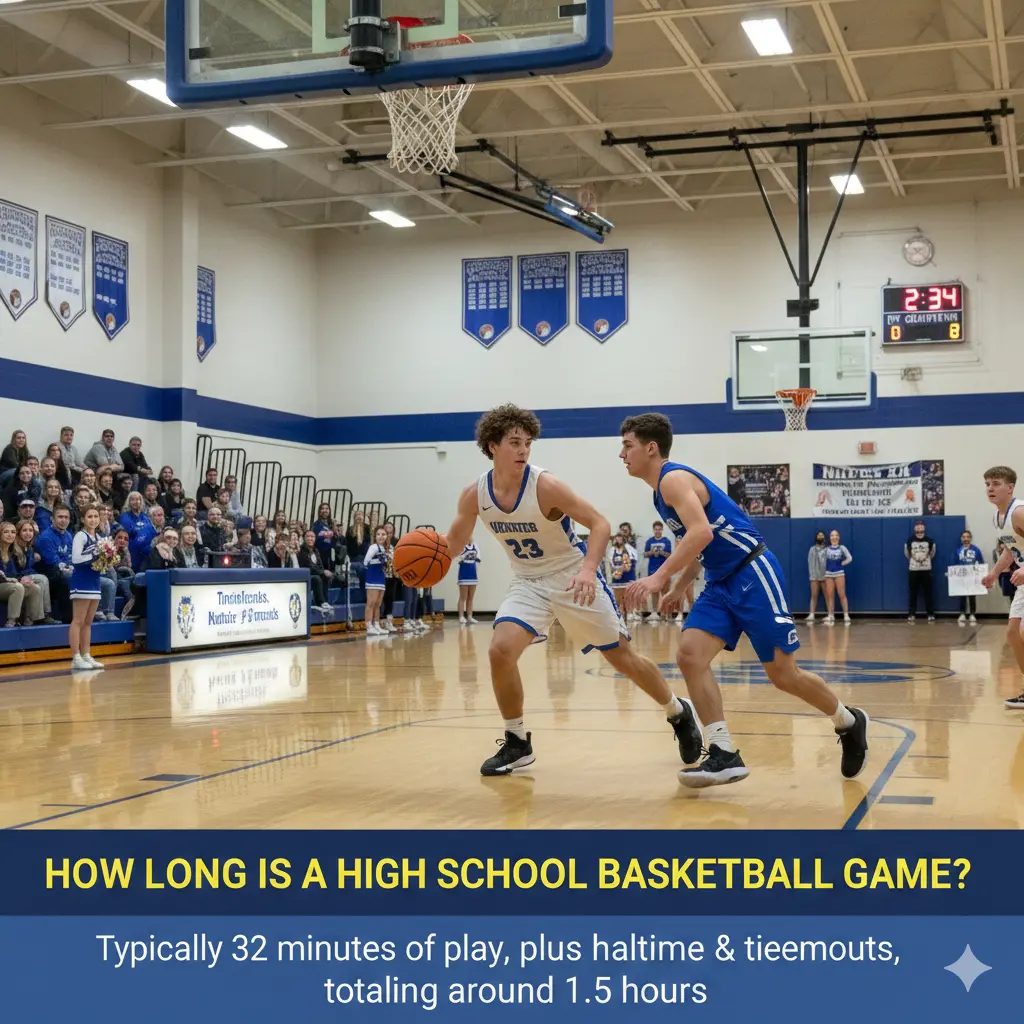
The pace is often faster and there are fewer timeouts than in professional games.
How long does a youth basketball game last?
Kids’ basketball games are the shortest and easiest.
- They often have:
- Shorter quarters
- Working clocks
- Shorter timeouts
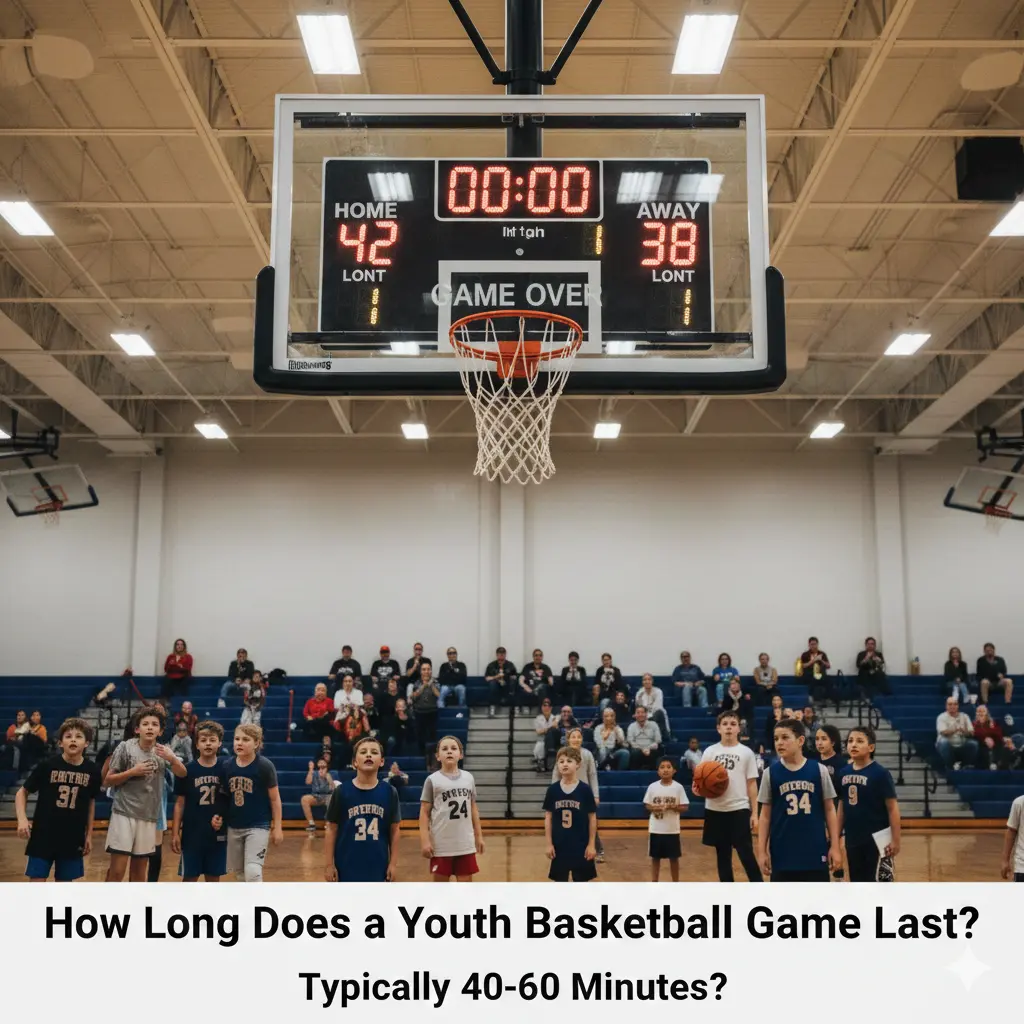
A lot of youth games last between 45 and 60 minutes. Learning, having fun, and staying active are more important than tough competition.
Do NBA and college basketball games have the same quarters?
No, the NBA and college basketball do not play by the same rules.
The NBA uses the traditional four-quarter system, while college basketball uses two halves. This difference affects how long the game lasts and how it feels.
College games have longer periods of play without breaks, while NBA games have more breaks.
Why College Basketball Has Two Halves
The game of college basketball was split into two halves to make it easier to play and keep a steady pace. It cuts down on the number of breaks and makes it easier for officials to deal with fouls.
Using halves also leads to a different way of doing things. Coaches plan the game in bigger parts instead of quarter by quarter.
How This Changes the Game’s Length
Even though there are fewer breaks, college basketball games can still take a long time. Late fouls, free throws, and close scores make the last few minutes last longer.
So, even though the format is different, people often spend about the same amount of time watching as they do professional games.
What Happens in Basketball Overtime If the Score Is Tied?
If the score is tied at the end of regulation time, the game goes into overtime.
Overtime gives the game more time to find a winner. If the teams stay close, the game can feel even longer than it already is.
How long does extra time in basketball last?
Most basketball leagues have overtime that lasts five minutes.
This includes the NBA, college basketball, and a lot of leagues from other countries. When there are fouls or whistles, the clock stops just like it does during regular play.
Can there be more than one overtime?
A basketball game can have more than one overtime.
If the score is still tied after one, there is another overtime. This process goes on until one team wins.
Some old games have had extra time added to them, making them much longer than usual.
What Could Make a Basketball Game Last Longer Than Expected?
Even if you know how many quarters there are, basketball games don’t always end on time.
Here are some common reasons why games take so long:
- Scores that are very close at the end
- A lot of free throws and fouls
- Using timeouts wisely
- Referees’ reviews of videos
- Times of extra work
The last five minutes of a close game can sometimes take up to twenty minutes in real time.
Why It’s Important to Know How Many Quarters Are in Basketball
Knowing how many quarters there are can make basketball more fun.
- You will know:
- As halftime gets closer
- Why does the game get slower at the end?
- How groups plan their strategies
How much time do we really have left?
It also helps you plan your time around a game or a broadcast.
Final Thoughts
Basketball looks simple on the surface, but its timing structure adds depth and excitement. Most games use four quarters, but not every level follows the same rules.
Knowing how many quarters in basketball, how long a college basketball game is, and how long a basketball game lasts can help you understand the game better.
Knowing the time, quarters, and breaks makes it easier to keep up with the action and enjoy every second of the game, no matter how long you’ve been watching.

A lot of players get confused because soccer and football cleats can look almost the same at first. But if you look a little closer, you’ll see that soccer and football cleats are different.
Soccer cleats are made to be lighter and more flexible so that players can move quickly, control the ball, and stay comfortable during long games. On the other hand, football cleats are more about protection and stability.
They have more padding and a different stud setup so they can handle harder hits and fast movements. Knowing these basic differences can help you make the right choice and get cleats that are right for the sport you play.
Main differences between soccer cleats and football cleats
The main differences between soccer and football cleats are how they are made and how they work on the soccer field. Football cleats are made for strength, traction, and physical play, while soccer cleats are made for speed, control, and smooth movement. Even small design choices can change how well you move and how safe you feel while playing.

Here are the main differences at a glance:
Layout of the stud: Football cleats have different patterns of studs to help players make quick cuts and strong push-offs, while soccer cleats have evenly spaced studs for balance and easy movement.
Toe stud: Football cleats have a toe stud to help with quick starts, but soccer cleats don’t have one to keep players safe and help them control the ball better.
Ankle support: Soccer cleats are usually low-cut so they can bend, but football cleats can be low, mid, or high-cut for more support.
Weight and build: Football cleats are stronger and can handle contact and impact better than soccer cleats.
Even though soccer and football cleats may look the same, these design choices make them not interchangeable.
Why Soccer Cleats Don’t Have a Toe Stud
There isn’t a toe stud on soccer cleats because the game requires close ball control, constant movement, and player safety. In soccer, you always play with your feet, so having a stud near your toe would make it hard to make clean touches, passes, and shots.
It could also make it more likely that you will step on another player during tackles or challenges, which is why soccer rules are very strict about how cleats can be made.
This is a big difference between soccer and football cleats: football players need a toe stud to help them explode forward from a standstill, while soccer players need a smooth, lightweight sole that keeps their foot close to the ball and lowers the risk of injury during fast-paced play.
Can you wear soccer cleats when you play football?
You can wear soccer cleats for football in some situations, but it really depends on the kind of football you’re playing. Soccer cleats are often good for non-contact sports like flag football because they are light, flexible, and made for quick cuts and speed.

This is where the main difference between soccer and football cleats comes into play: football cleats are made for heavy contact, while soccer cleats are made for moving and controlling the ball. Soccer cleats are not the best choice for full-contact football, though.
They don’t have the extra support, thicker studs, and toe traction that help players push, block, and take hits. Some positions, like kickers, may still like soccer cleats better because they feel better and help them kick more accurately, but for most players, football cleats are safer. Wearing the right cleats can help you play better and lower your risk of getting hurt.
When Soccer Shoes Can Be a Problem on the Field
Problems can happen quickly when soccer cleats are used on a football field. The biggest difference between soccer and football cleats is traction. Soccer cleats don’t have a front toe stud, which makes it harder to explode off the line or change direction quickly.
Football has more contact and sharper cuts, and soccer cleats don’t give the same support or stability, which makes it more likely that you will roll your ankles or hurt your feet.
Also, football is harder on gear, so soccer cleats tend to wear out or break much faster. Some leagues also have rules about what kind of cleats you can wear, so wearing the wrong pair could keep you from playing at all.
Last Thoughts
A lot of players don’t think about it, but the difference between soccer and football cleats really does matter. At first glance, they may look the same, but each pair is made for a different type of movement, contact, and field use.
Wearing the right cleats will help you stay balanced, avoid getting hurt, and play with confidence during the game. Soccer cleats can work in some situations, but if you’re serious about football, you should get the right football cleats. They’re safer and smarter. Choosing the right shoes for your sport isn’t just about comfort; it’s also about playing better and staying safe on the field.

Early this morning, Buffalo gave us shocking news: the Buffalo Bills’ new stadium caught fire. The unexpected event at New Highmark Stadium shocked both fans and people who lived nearby.
The stadium, which opened not too long ago and cost about $2.1 billion to build, is one of the most modern and high-tech sports venues in the country. Even though it has the best facilities, early reports say that a fire broke out in the morning, which made emergency services respond right away.
Authorities haven’t yet released all the information about what caused the fire or how much damage it did. Fans posted videos and pictures of smoke coming from the stadium on social media, which sparked a lot of worry and talk online.
The Buffalo Bills are likely to make an official statement soon. In the meantime, local fire departments are working to put out the fire and keep people safe in the area.
Fans are worried about possible damage to the stadium because of this unexpected event. The stadium is now a major landmark and home to thousands of fans on game days.
We will keep a close eye on this story and let you know when we learn more.

Before the game, Mack Hollins was once again the center of attention, but this time it had nothing to do with how he played. The New England Patriots wide receiver showed up at Gillette Stadium without a shirt or shoes on, and snow was falling before the game against the Buffalo Bills on Sunday.
Most players came in heavy coats, boots, and winter gear, but Hollins calmly walked through the snowy stadium entrance in just shorts. The temperature in Foxborough was just below freezing, and weather reports said that it could snow up to three inches during the day. Hollins looked calm and relaxed as he walked inside, even though it was cold.

Video of his arrival quickly spread online, and fans reacted on social media. A lot of people were surprised by his choice, but others said that this is something he does all the time. Hollins has a reputation for showing up to games without shoes, even when it’s cold outside. He thinks this helps him stay mentally ready and focused.
The strange entrance made an already important matchup even more interesting. The Patriots and Bills were going to have to deal with bad weather, like snow and freezing temperatures that would make it hard to play. Players on both teams got ready for a tough game, knowing that the weather could affect how they passed, how they stood, and how they controlled the ball.
As the kickoff time got closer, Hollins’ arrival became one of the most talked-about events of the day. The veteran receiver once again showed that he does things his own way, turning a cold, snowy morning into a moment that fans will remember for a long time. It could have been a personal ritual or a show of toughness.
-

 News2 weeks ago
Aa73 emergency landing Story
-

 Finance1 month ago
FSI Blogs Us: The Best Resources for Financial Services industry
-

 News1 week ago
Piloto American Airlines niño Trending Story
-

 Travel3 weeks ago
Delta Flight DL275 Diverted LAX: What Really Happened Mid-Air
-

 Technology1 month ago
Tesla Gen-3 Optimus: Humanoid Robot for Everyday Tasks
-

 Blog1 month ago
BabydollKaila: How She Became a Social Media Sensation
-

 Health2 weeks ago
Delta Fitness Authority: Your Complete Guide to Transformation
-

 Business1 month ago
SQRWomensRestroom: Key Information for Visitors and Facility Management Teams